In this post, I’ll walk you through how I approached optimizing the
1D convolution kernel, from the initial naive version to the final
implementation. I’ll also cover some of the key CUDA concepts and
performance tricks that helped along the way. You can find the code on
my
 GitHub .
The task is to compute the convolution of a 1D \(\text{input}\) array with a \(\text{mask}\) defined as follows:
\[ \text{output}[i] = \sum_{j=0}^{\text{mask\_size}-1} \text{input}[i+j] \cdot \text{mask}[j] \]
where \(i\) ranges from \(0\) to \(\text{input\_size} - \text{mask\_size}\).
We will try to optimize the kernel for convolution as much as possible on NVIDIA T4 and benchmarking on a test case with \(\text{input\_size} = 1000000\) and \(\text{mask\_size} = 2047\).
The naive approach is to assign each thread to one output element and compute the convolution directly. This results in a kernel that looks like this:
    // input, mask, and output are stored in global memory
    int idx = blockIdx.x * blockDim.x + threadIdx.x;
    int output_size = input_size - mask_size + 1;

    if (idx < output_size) {
        float sum = 0.0f;
        for (int j = 0; j < mask_size; ++j) {
            sum += input[idx + j] * mask[j];
        }
        output[idx] = sum;
    }
I did a hyperparameter search for the best
THREADS_PER_BLOCK value, the block size and found that
\(512\) threads per block is the best.
The results are as follows:
THREADS_PER_BLOCK=512
naive : 4.57051 ms, 0.895742 GFLOPS
This kernel does a lot of global memory accesses, which are
relatively slow. We can already spot a few inefficiencies: 1.
mask reads are not coalesced. 2. input reads
are coalesced, but redundant. The same goes for mask.
So we will try next to optimize the memory accesses. But first, let’s see another way to arrive at the same conclusion.
The NVIDIA T4 GPU has a peak performance of \(8.1408\ \text{TFLOPs/s}\) (FP32) and a
memory bandwidth of \(320.06\
\text{GB/s}\). This means that for each byte read from memory,
the hardware can ideally perform
\[
\frac{8.1408 \times 10^{12}}{320.06 \times 10^9} = 25.44\ \text{FLOPs}.
\]
Next, let’s look at how many FLOPs our naive kernel does per byte read. This is called the arithmetic intensity (AI).
Our kernel reads \(2 \cdot
\text{mask\_size}\) floats per output element (one for
input, one for mask), so a total of \(8 \cdot \text{mask\_size}\) bytes. It
performs \(2 \cdot \text{mask\_size}\)
FLOPs (one multiply and one add per input-mask pair). So the arithmetic
intensity is:
\[ \text{AI} = \frac{2 \cdot \text{mask\_size}}{8 \cdot \text{mask\_size}} = \frac{1}{4}. \]
This means the kernel does only \(0.25\ \text{FLOPs}\) per byte read; far below the hardware limit of \(25.44\). In other words, performance is limited by memory throughput, not computation. This is a memory-bound kernel. To improve performance, we must increase arithmetic intensity, either by reducing memory accesses or doing more computation per byte loaded.
To optimize memory accesses, we will use two techniques:
1. Constant memory The \(\text{mask}\) array is small and constant throught the kernel execution. We can store it in constant memory, which is cached in a read-only cache. To use constant memory, we just need to declare mask as follows:
__constant__ float cmem_mask[MASK_SIZE];and copy the date to it from mask using
cudaMemcpyToSymbol(cmem_mask, mask_data, sizeof(float) * mask_size);2. Shared memory Shared memory is shared among all
threads in a block. It is on-chip memory and is much faster than global
memory (faster than L1 cache with proper access). We will use it to
cache the needed input data and then have fast reads during the
convolution computation. All threads in a block will collaborate and
load the needed data from input into shared memory, in a
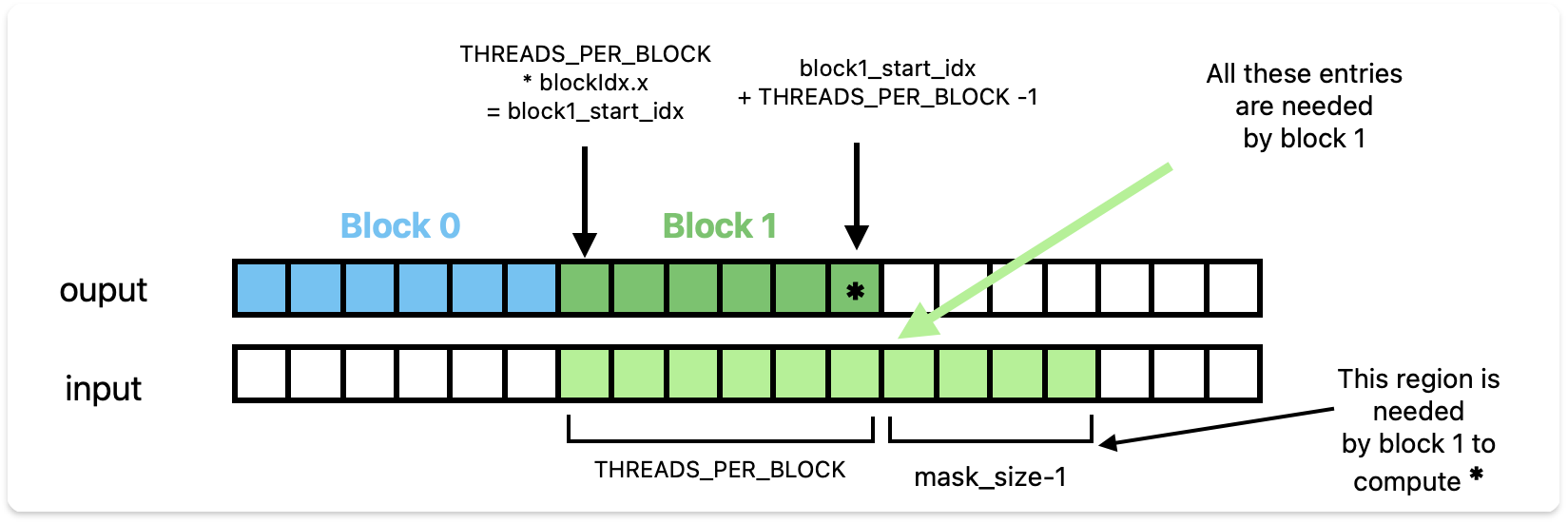
coalesced manner. Altought a block is responsible for
THREADS_PER_BLOCK output elements, it needs
THREADS_PER_BLOCK + mask_size - 1 input elements to compute
them. See figure below for a visual representation of this :
Can we fit that many data in shared memory? Yes !
Each SM has 64Kb of shared memory, that’s 16K floats. And each SM can
launch 1024 threads at a time. If we choose a block size of 1024, we
will need to store 1024 + 2047 - 1 = 3070. So we can store
more than 4 times that in shared memory. Meaning we can also do block
sizes of 512, 256.
The interesting parts of the code become as follows:
// idx of the first output element that the block is responsible for
const size_t block_start =  blockDim.x * blockIdx.x ;
// idx of the output element that this thread is responsible for
const size_t tid = threadIdx.x + block_start ;

extern __shared__ float smem_input[]; // shared memory

const size_t smem_len = blockDim.x + kernel_size - 1; // block region + halo region

// all threads collaborate to load data from gmem to smem
for (size_t i = threadIdx.x; i < smem_len ; i += blockDim.x) {
    size_t global_idx = block_start + i;
    if (global_idx < input_size)
        smem_input[i] = input[global_idx];
}

// wait for all threads to finish the transfer
__syncthreads();

if (tid > input_size - kernel_size)
    return;

// compute the convolution
float sum = 0 ;
for(size_t i = 0 ; i < kernel_size ; i++){
    sum += smem_input[threadIdx.x +i] * cmem_kernel[i];
}
// save the result to global memory
output[tid] = sum ;
Note that in the transfer from gmem to smem, we are using a coalesced access pattern : consecutive threads in a warp, read consecutive elements from global memory.
The best block size is still 512, and the runtime is now :
naive : 4.60465 ms, 889.101 GFLOPS
smem  : 4.67256 ms, 876.179 GFLOPS
This is disappointing. The shared memory kernel is slightly slower
than the naive one. To understand why, we need to profile both our
kernels with ncu :
ncu --set full ./benchmark naive
ncu --set full ./benchmark smem
This shows us a lot of information, let’s scroll down to the memory section and look at the L1 and L2 hit rates
| Kernel Type | L1 Hit Rate | L2 Hit Rate |
|---|---|---|
| Naive | 99.67% | 89.77% |
| Shared Mem | 99.21% | 74.78% |
We can see that the naive kernel makes a really good use the caches.
As the L2 cache is 6MB it probibly fits the whole input array. The
mask array also must reside in the L2 cache and is loaded
once per SM to the L1 and then is always fetched from there.
But shared memory is typically faster than L1 cache, so why is the shared memory kernel slower? Let’s look at other metrics:
| Kernel Type | naive | smem |
|---|---|---|
| Executed Instructions | 225,949,855 | 355,003,467 |
| Warp Cycles Per Issued Instruction | 38.41 | 24.18 |
| Instructions Per Cycle | 0.82 | 1.28 |
Let’s analyze and understand these numbers. Warp Cycles Per Issued Instruction tells us how many cycles it takes for a warp to issue an instruction. A higher value means the warp spends more time waiting between instructions, indicating potential inefficiencies.
Both kernels spend a significant number of cycles waiting between instructions, but the shared memory (smem) kernel spends less time waiting (24.18 cycles/instruction) compared to the naive kernel (38.41 cycles/instruction) a factor of 1.59 improvement. However, the smem kernel executes significantly more instructions (355M vs 225M) a factor of 1.57 ! Which cancels out the improvement and result in similar runtimes.
This is consistent with the fact that the Instructions Per Cycle (IPC) is higher for the smem kernel (1.28) than for the naive kernel (0.82), indicating that the smem kernel is utilizing the GPU more efficiently per cycle, even though it performs more work overall.
Finally, for the smem solution, the profiler indicates that shared memory loads account for 40% of the kernel’s waiting time between instructions. This is likely due to the presence of many bank conflicts, which can significantly increase shared memory access latency.
All this points us to the next strategy : Less shared memory reads and more computation.
We need to do more computation per element loaded from shared memory to reduce shared memory read overhead. To achieve this, each thread will compute two output elements at once.
Instead of loading entries from input multiple times,
each thread will load the necessary values from shared memory into
registers once and use them to compute two output elements. This
approach will halve the number of shared memory reads
and reduce bank conflicts.
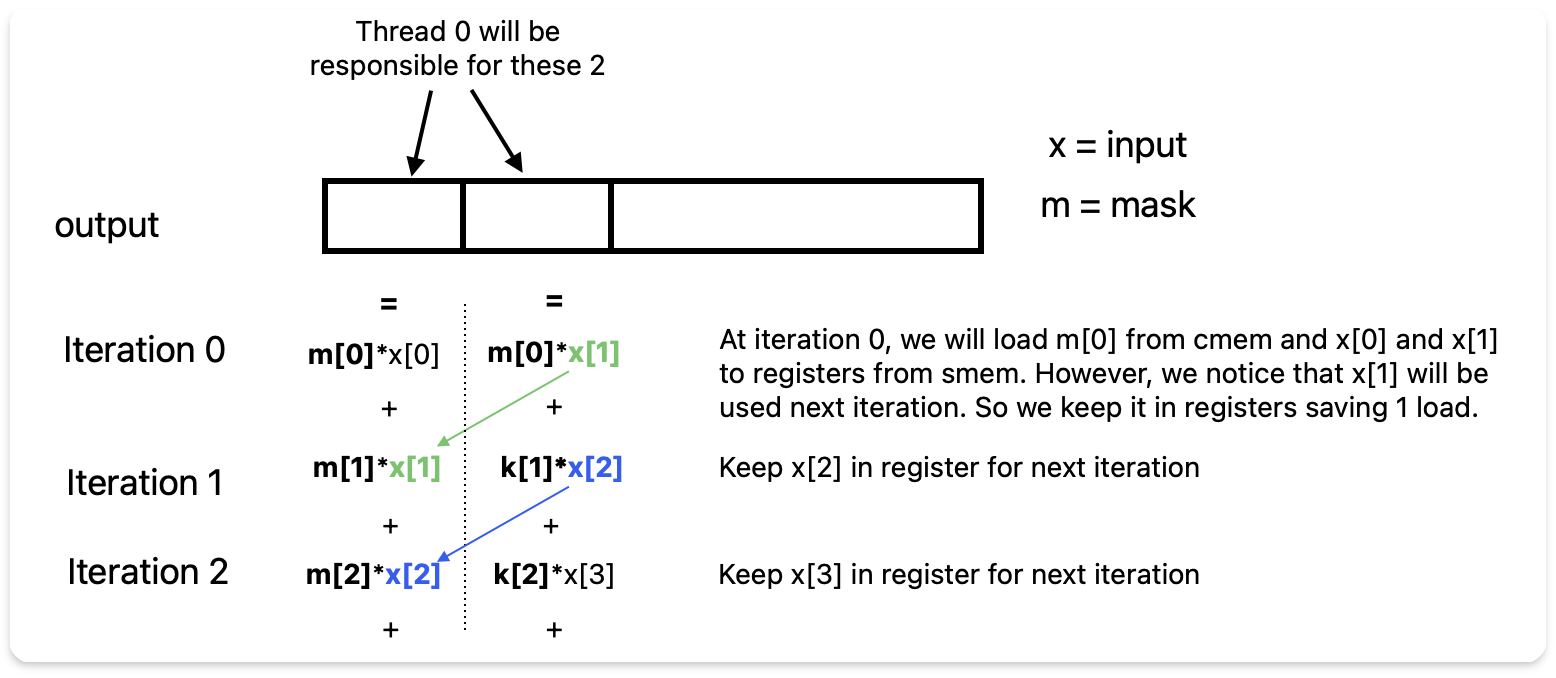
To understand this better, consider how mask[0]
contributes to the outputs:
mask[0] contributes to output[0] as
input[0] * mask[0]mask[0] contributes to output[1] as
input[1] * mask[0]Similarly, mask[1] contributes:
output[0] as input[1] * mask[1]output[1] as input[2] * mask[1]We observe that input[1] is used in computing both
outputs and can be loaded once into registers. Only
input[2] needs to be loaded additionally.
We repeat this sliding window pattern for mask_size
iterations, we effectively compute two outputs with twice fewer shared
memory loads.
The diagram below illustrates this approach:
The code for this is :
const size_t block_output_idx_start =
    (size_t)blockIdx.x * blockDim.x * OUTPUTS_PER_THREAD;
const size_t thread_output_idx_start =
    block_output_idx_start + threadIdx.x * OUTPUTS_PER_THREAD;

// GMEM to SMEM transfer happens like in previous kernel
// We just need to adapt the indexing.
__syncthreads();

if (thread_output_idx_start >= output_size) {
    return;
}

float reg_output[2] = {}; // output registers
float reg_input[2]; // input registers

// load first two elements into input registers
reg_input[0] = shared_input[threadIdx.x * 2 ] ;
reg_input[1] = shared_input[threadIdx.x * 2 + 1] ;

for (int k = 0; k < kernel_size; ++k) {
    const float k_val = cmem_mask[k] ;
    reg_output[0] += k_val * reg_input[0]; // update first output register
    reg_output[1] += k_val * reg_input[1]; // update second output register

    reg_input[0] = reg_input[1] ; // shift input registers to reuse next iteration
    reg_input[1] = shared_input[threadIdx.x * 2 + k + 2]; // load new element from smem
}

// write output from registers to gmem
output[thread_output_idx_start] = reg_output[0] ;
if (thread_output_idx_start + 1 < output_size )
    output[thread_output_idx_start + 1] = reg_output[1];
Now that you got the idea, let’s generalize this to compute
OUTPUTS_PER_THREAD outputs per thread. This results in the
the code below :
const size_t block_output_idx_start =
    (size_t)blockIdx.x * blockDim.x * OUTPUTS_PER_THREAD;
const size_t thread_output_idx_start =
    block_output_idx_start + threadIdx.x * OUTPUTS_PER_THREAD;

// GMEM to SMEM transfer happens like in previous kernel
__syncthreads();

if (thread_output_idx_start >= output_size) {
    return;
}

float reg_output[OUTPUTS_PER_THREAD] = {}; // output registers
float reg_input[OUTPUTS_PER_THREAD]; // input registers

// filling input registers from smem
#pragma unroll
for (int n = 0; n < OUTPUTS_PER_THREAD; ++n)
    if (threadIdx.x * OUTPUTS_PER_THREAD + n < smem_size )
        reg_input[n] = smem_input[threadIdx.x * OUTPUTS_PER_THREAD + n] ;

for (int k = 0; k < kernel_size; ++k) {
    const float k_val = cmem_kernel[k];

    #pragma unroll
    for (int n = 0; n < OUTPUTS_PER_THREAD; ++n){
        reg_output[n] += k_val * reg_input[n]; // updating output registers
    }

    #pragma unroll
    for (int n = 0; n < OUTPUTS_PER_THREAD-1; ++n){
        reg_input[n] = reg_input[n+1]; // shifting registers
    }

    reg_input[OUTPUTS_PER_THREAD-1] = // load new element from smem
        smem_input[threadIdx.x * OUTPUTS_PER_THREAD + k + OUTPUTS_PER_THREAD];
}

#pragma unroll
for (int n = 0; n < OUTPUTS_PER_THREAD; ++n) {
    if (thread_output_idx_start + n < output_size) {
        // write output from registers to gmem
        output[thread_output_idx_start + n] = reg_output[n];
    }
}
We just need to set OUTPUTS_PER_THREAD to 8 and do the
hyperparameter search again over block size. We get the following
results :
naive     : 4.60465 ms, 889.101 GFLOPS
smem      : 4.67256 ms, 876.179 GFLOPS
reg_block : 0.894524 ms, 4 576.73 GFLOPS
A factor of approximaly 5.16x improvement over the naive kernel and a factor of 5.24x over the shared memory kernel!
First, all the kernels above initialize cmem_mask to a
size of 2048 instead of 2047. I noticed it brings a slight improvement
in performance.
These are the micro-optimizations I added to the previous kernels and that worked :
__ldg(input+global_idx) instead of
input[global_idx] to read from global memory. This uses a
read-only cache that can improve performance for our constant data.__align__(64) float cmem_mask[MASK_SIZE]; to align the
constant memory to 64 bytes. This is the size of a cache line, and it
can improve cache performance. I am not an expert on this, if you know
more about this or have good resources, please let me know.With these additions, we get the following results :
naive     : 4.60465 ms, 889.101 GFLOPS
smem      : 4.67256 ms, 876.179 GFLOPS
reg_block : 0.894524 ms, 4576.73 GFLOPS
micro_opt : 0.868636 ms, 4713.14 GFLOPS
I also tried vectorizing the kernel using float4 types,
but it didn’t improve performance. I don’t know the reason for that. The
code is on my github. If you have any insights, please let me know.
Shared memory does not always improve performance. In these cases, profiling is key to understand the bottlenecks. In memory-bound kernels, increases the computation per memory access is the way to go.